CE Marking for Machinery: Process, Obligations and What Changes in 2027

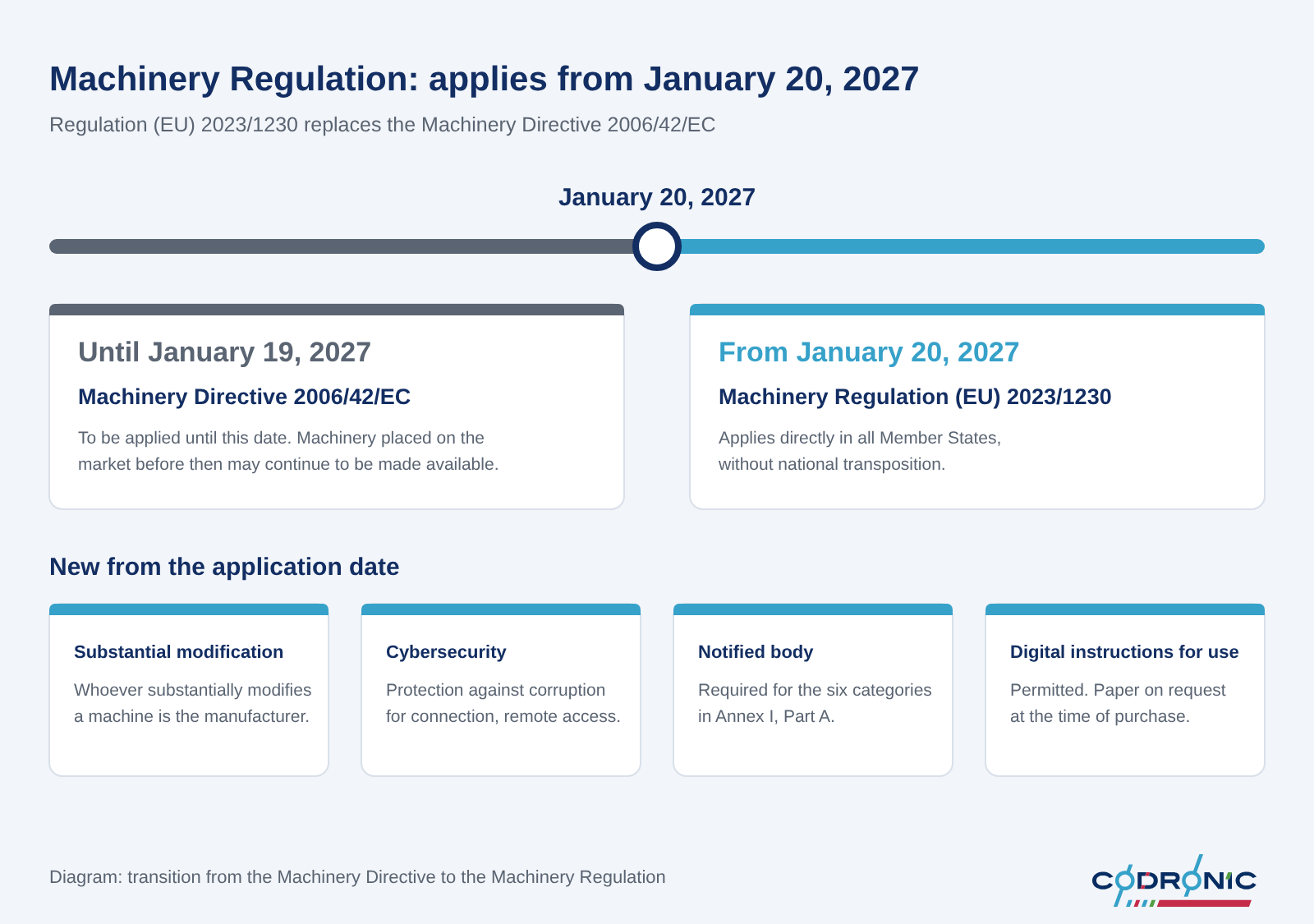
From January 20, 2027, the Machinery Regulation (EU) 2023/1230 applies to machinery. It replaces the Machinery Directive 2006/42/EC, which is to be applied until January 19, 2027. The CE marking remains the mark by which the manufacturer declares that its machine meets all applicable EU requirements. CE marking for machinery follows seven steps that apply to every machine.
Key points
- The manufacturer is always responsible for CE marking. Whoever substantially modifies a machine is considered a manufacturer.
- The core of every proof of conformity is the risk assessment in accordance with EN ISO 12100.
- The technical documentation and the declaration of conformity remain available to market surveillance for at least ten years.
- From January 20, 2027, new requirements apply, including on cybersecurity (protection against corruption) and on digital instructions for use.
What does the CE marking stand for?
The CE marking is not a test seal issued by an authority. The manufacturer affixes it and thereby confirms that it has demonstrated conformity with the applicable EU legal acts. For machinery, in addition to the Machinery Directive or the Machinery Regulation, these are often the EMC Directive 2014/30/EU and, depending on the design, the Pressure Equipment Directive 2014/68/EU or the Radio Equipment Directive 2014/53/EU. There is no official CE certificate. A notified body is mandatory only for certain categories of machinery.
The CE marking process in seven steps
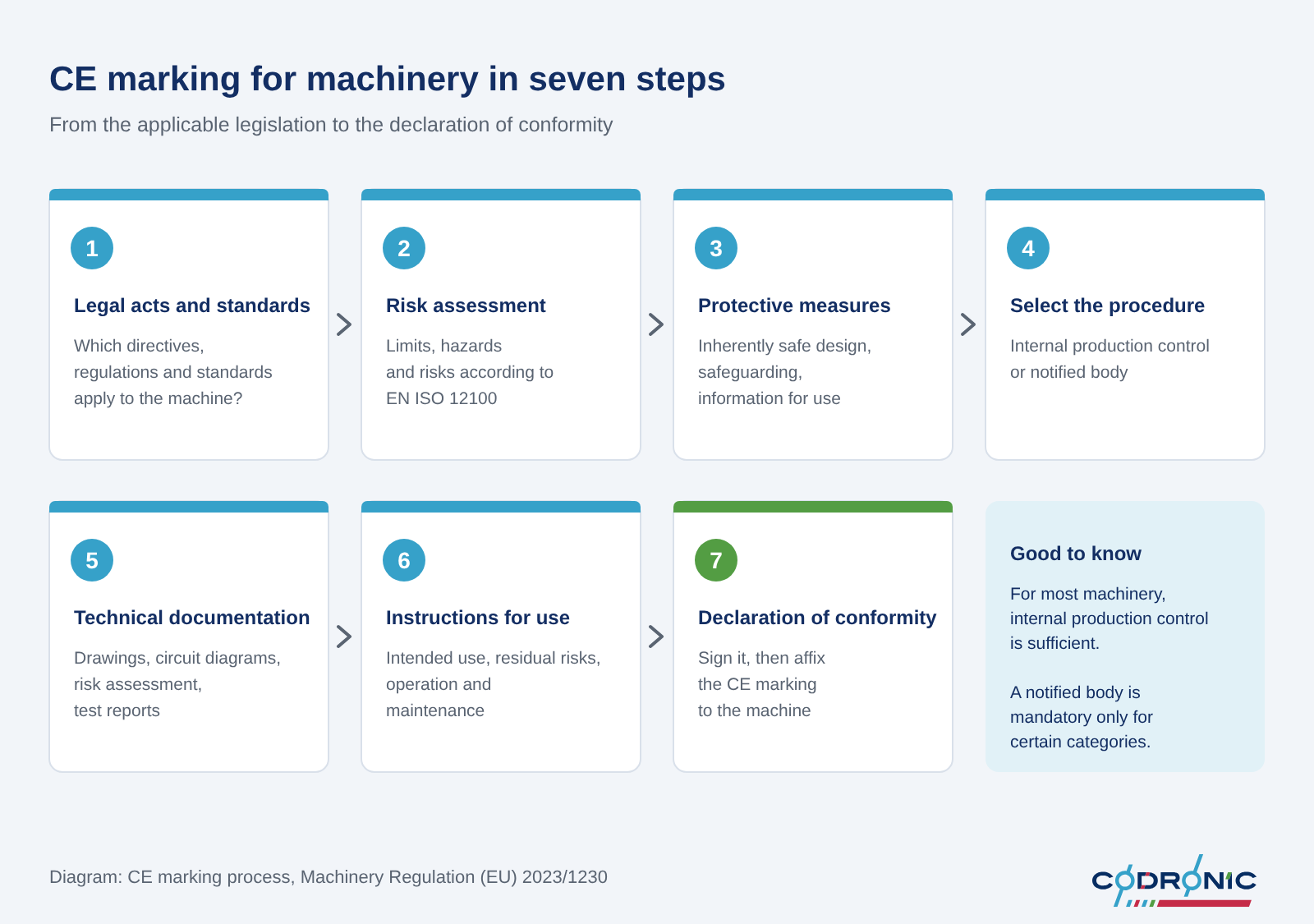
1. Determine the applicable legal acts and standards
The first question is which directives and regulations apply to the machine and which harmonized standards specify the requirements. Harmonized standards whose references have been published in the Official Journal of the EU give rise to a presumption of conformity: the requirements they cover are presumed to be met.
2. Carry out the risk assessment
The risk assessment in accordance with EN ISO 12100 determines the limits of the machine, identifies the hazards across all phases of its life cycle and evaluates the risks. The necessary protective measures follow from it. Ideally, it starts with the requirements specification (in German). Without a risk assessment, no proof of conformity is sound.
3. Implement the protective measures
The order is fixed: first inherently safe design, then safeguarding, finally information for use. Safety functions of the control system are designed and validated in accordance with EN ISO 13849-1 (Performance Level) or EN IEC 62061 (SIL).
4. Select the conformity assessment procedure
For most machinery, internal production control by the manufacturer is sufficient. Annex I to the Machinery Regulation lists the categories with a higher risk. For the six categories in Part A, a notified body is always involved. For the categories in Part B, internal production control is sufficient only if the manufacturer applies harmonized standards or common specifications that cover all relevant requirements.
5. Compile the technical documentation
The technical documentation provides the evidence: description of the machine, drawings and circuit diagrams, risk assessment, standards applied, test reports and instructions for use. After the machine has been placed on the market, the manufacturer keeps the documentation available for the market surveillance authorities for at least ten years.
6. Prepare the instructions for use
The instructions for use describe the intended use, residual risks, putting into service, operation and maintenance in a language determined by the Member State concerned. From January 20, 2027, they may be provided in digital format. If the customer requests a paper version at the time of purchase, the customer receives it free of charge within one month. If the machine is also intended for non-professional users, the safety information is still supplied on paper.
7. Issue the declaration of conformity and affix the CE marking
By signing the declaration of conformity, the manufacturer assumes responsibility for conformity. The manufacturer then affixes the CE marking to the machine visibly, legibly and indelibly.
What changes with the Machinery Regulation on January 20, 2027?
- Legal form: The regulation applies directly in all Member States, without national transposition.
- Substantial modification: Whoever substantially modifies a machine by physical or digital means after it has been placed on the market is considered a manufacturer and bears the manufacturer’s obligations. This can affect conversions, retrofits (in German) and new control systems.
- Cybersecurity (protection against corruption): The machine must be built so that the connection of another device or remote access does not lead to a hazardous situation.
- Self-learning systems: Safety components and machinery with systems that show self-evolving behavior using machine learning approaches and ensure safety functions belong to Annex I, Part A.
- Notified bodies: For the six categories in Annex I, Part A, a notified body is mandatory, even if the manufacturer applies harmonized standards.
- Digital instructions for use: permitted, paper on request at the time of purchase.
Checklist: Is your machine ready for 2027?
- Which machines will you place on the market from January 20, 2027?
- Is there a current risk assessment in accordance with EN ISO 12100 for each machine?
- Are the safety functions validated in accordance with EN ISO 13849-1 or EN IEC 62061?
- Does a machine fall into a category in Annex I to the Machinery Regulation?
- Are interfaces and remote access secured so that they cannot lead to a hazardous situation?
- Are you planning conversions of existing machines that may be a substantial modification?
- Are the instructions for use prepared for digital provision?
Frequently asked questions about CE marking
Who is responsible for CE marking?
The manufacturer. Whoever places a machine on the market under their own name or substantially modifies it is also considered a manufacturer. An engineering firm prepares the risk assessment and the documentation; the responsibility remains with the manufacturer.
When does the Machinery Regulation apply?
From January 20, 2027. Until January 19, 2027, the Machinery Directive 2006/42/EC applies. Machinery placed on the market before that date in accordance with the Directive may continue to be made available.
Does every machine need a notified body?
No. Most machinery goes through internal production control. A notified body is mandatory for the six categories in Annex I, Part A, and for Part B if the manufacturer does not apply harmonized standards or common specifications that cover all relevant requirements.
How long must the technical documentation be kept?
At least ten years after the machine has been placed on the market.
What applies to partly completed machinery?
It does not receive a CE marking. It receives an EU declaration of incorporation and assembly instructions. The manufacturer of the complete machine affixes the CE marking.
In practice at Codronic GmbH
We know the entire path from our own experience. We developed our product Pressmetrics ourselves as a machine and prepared all CE documentation for it, from the risk assessment to the declaration of conformity. For a customer, we are currently preparing the complete CE documentation for a special-purpose machine, a casting machine with special requirements. We also develop, build and deliver fixtures and tools for aviation, each with the associated CE documentation.

For conversions of existing systems, we assess whether there is a substantial modification. More on the page Conformity & Documentation.
About the author
Michael Mader founded Codronic GmbH in Friedberg near Augsburg in 2009 and leads it as Managing Director. A trained toolmaker with technician training (Technikerschule) and university studies in business and economics, he is responsible for development, calculation and conformity projects in mechanical engineering. He is the inventor of patent DE 10 2024 136 675 B3.
Sources
- Regulation (EU) 2023/1230 on machinery, Articles 3, 10, 11, 18, 20, 25, 51, 52 and 54, Annexes I and III, accessed November 10, 2026.
- Directive 2006/42/EC on machinery.
Legal status checked on November 10, 2026.


Suspected POPs Cases: How Manufacturers Find Banned Substances in the Supply Chain

Fasteners – High-Tech in a Humble Guise
