Suspected POPs Cases: How Manufacturers Find Banned Substances in the Supply Chain

Almost one in ten products that European authorities checked against the POPs Regulation in the REF-10 enforcement project was non-compliant: 61 of 645. The regulation has banned persistent organic pollutants (POPs) for years. They are still found in soft and hard plastics, and therefore in parts that manufacturers purchase. This article shows where the risk comes from and how manufacturers resolve a suspected case in five steps.
Key points
- The POPs Regulation (EU) 2019/1021 prohibits the manufacturing, placing on the market and use of the listed substances, including in mixtures and articles.
- In the ECHA project REF-10 (report of December 2023), 61 of 645 products checked did not comply with the POPs Regulation, mostly because of short-chain chlorinated paraffins (SCCPs) in soft plastics.
- In Germany, a violation of the POPs substance ban is a criminal offense, even in cases of negligence (Section 27 ChemG, the German Chemicals Act, in conjunction with Section 10 ChemSanktionsV, the German ordinance on sanctions under chemicals law). Violations of the RoHS obligations listed in Section 14 ElektroStoffV, the German ordinance that implements the RoHS Directive, can be penalized as a regulatory offense.
- A supplier declaration is a start. It becomes reliable when it names the material and the testing of the specific component.
What did REF-10 find?
In December 2023, the European Chemicals Agency (ECHA) published the report on the REF-10 enforcement project. Authorities from 26 countries checked 2,407 products against REACH, RoHS, the POPs Regulation and the Toy Safety Directive. 18% of the products did not comply with at least one restriction.
Electrical and electronic products performed worst: 170 of 329, or 52%, were non-compliant. Most of these cases concerned RoHS (96%).
The results for the POPs Regulation:
| Substance | Checked | Non-compliant | Share |
|---|---|---|---|
| SCCPs (short-chain chlorinated paraffins) | 461 | 52 | 11% |
| PFOA (a PFAS substance) | 131 | 7 | 5% |
| HBCDD (flame retardant) | 85 | 1 | 1% |
| POPs Regulation total | 645 | 61 | 9% |
The table shows the three most frequent substances. Source: ECHA REF-10 project report, Tables 5 and 6.
The authorities were free to select the products. The rates are therefore not a market average. They apply to the product groups checked. For manufacturers, this means: where inspectors look, they regularly find banned substances.
What does the POPs Regulation cover?
POPs stands for persistent organic pollutants. They barely degrade in the environment, accumulate in organisms and spread over long distances.
Regulation (EU) 2019/1021 lists these substances in Annex I. Article 3(1) prohibits their manufacturing, placing on the market and use, whether on their own, in mixtures or in articles. For unintentional trace contaminants, Annex I sets limits. The list is growing: Dechlorane Plus has been listed in Annex I since October 2025, and stricter limits for PFOS have applied since December 2025.
In practice, this means: every purchased component counts. Cables, seals, hoses, housings and assemblies carry the risk into your own product.
Why is the risk higher than with RoHS?
Under German law, the legal consequences differ considerably:
- RoHS: Anyone who intentionally or negligently places electrical equipment containing prohibited substances on the market commits a regulatory offense (Section 14 ElektroStoffV).
- POPs Regulation: Anyone who intentionally or negligently violates the substance ban under Article 3(1) commits a criminal offense (Section 10 ChemSanktionsV in conjunction with Section 27 ChemG). The penalty is imprisonment of up to two years or a fine in cases of intent, and up to one year or a fine in cases of negligence.
Negligence does not require intent. Recognizable warning signs are therefore part of the duty of care: an outdated supplier declaration, missing material information, a notice from market surveillance.
Where does the gap in the supply chain arise?
An electrical device consists of printed circuit boards, connectors, cables, seals and housings from different suppliers. These suppliers in turn source their materials from upstream suppliers. With each tier, visibility of the actual formulation decreases.
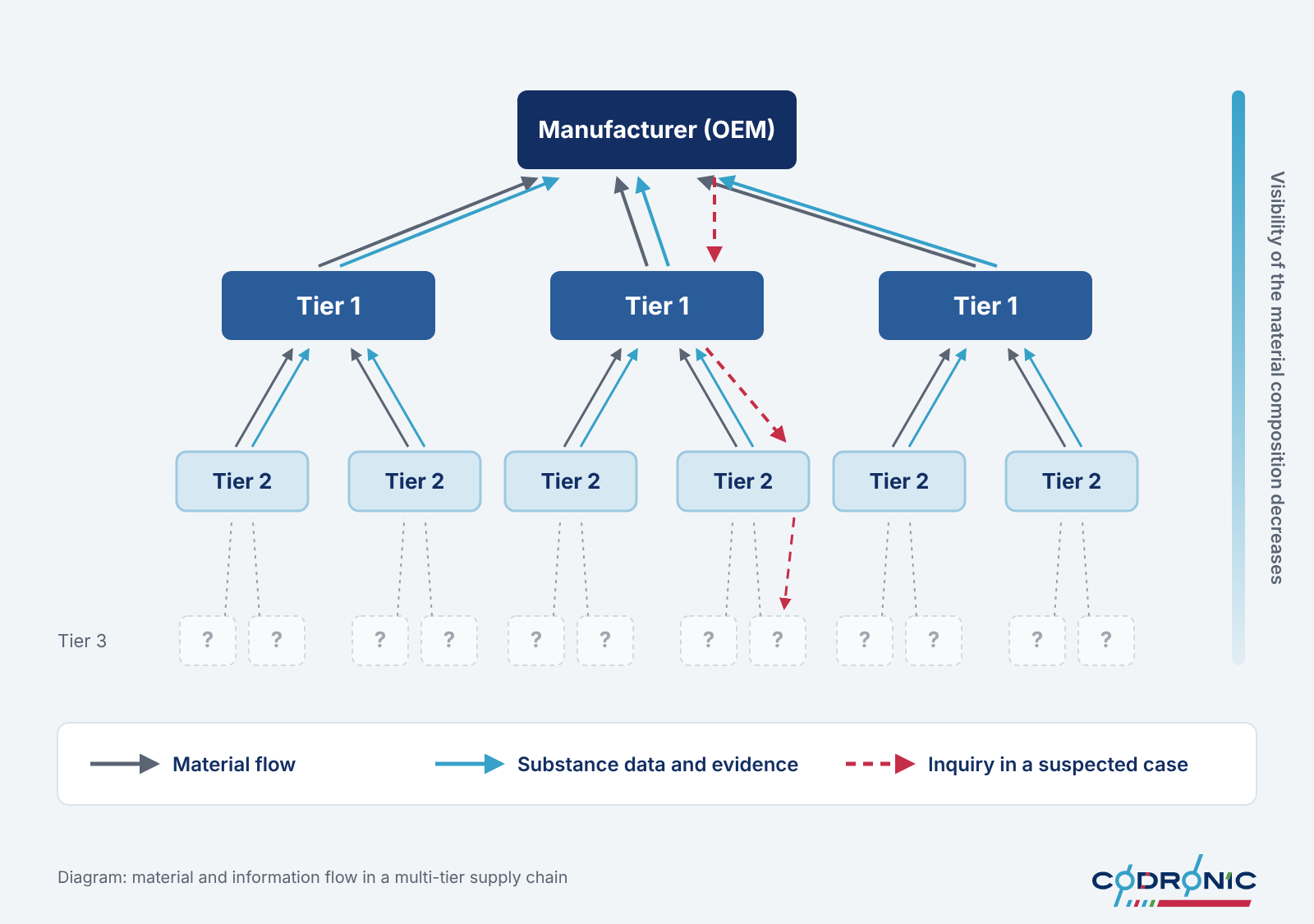
A general declaration of conformity rarely names the material, the substances tested and the test method. If the upstream supplier changes its formulation or a substance is newly added to the list, the declaration loses its basis. Product compliance is therefore a task across the entire life cycle (in German) of the product, for substance bans as much as for CE marking.
Five steps for a suspected POPs case
- Narrow down the risk. Which components are made of materials in which POPs are typical? In REF-10, POPs were found most often in soft plastics (SCCPs). Flame-retarded hard plastics are the second focus (HBCDD, PBDEs).
- Check existing data. Assign supplier declarations, material data sheets and IMDS or CDX entries to the affected components. Record the date and the scope of each declaration.
- Ask targeted questions. Ask the supplier for the material, the substance list and the basis of testing, for the specific part number.
- Have it tested if the information conflicts. If information is missing or contradictory, a test report or a laboratory material analysis provides clarity.
- Document the result. File the finding, source and date for each component in the technical documentation. This data basis holds up when suppliers change, formulations change or new substance bans arrive.

Digital material data
With many suppliers and variants, a material compliance system pays off. It assigns substance data and evidence to the components and compares them with the lists from REACH, RoHS and the POPs Regulation. When a substance is newly listed, the system lists the affected parts. IMDS is established for this in the automotive industry, and CDX across industries.
In practice: all components classified, suspected cases tracked openly
In one project, we checked and classified all components of a product against the applicable EU substance regulations, component by component along the bill of materials. The substance list of the POPs Regulation is growing continuously, and many supply chains still provide incomplete substance data, much as in the first years of REACH. For individual components, the absence of POPs was therefore not documented.
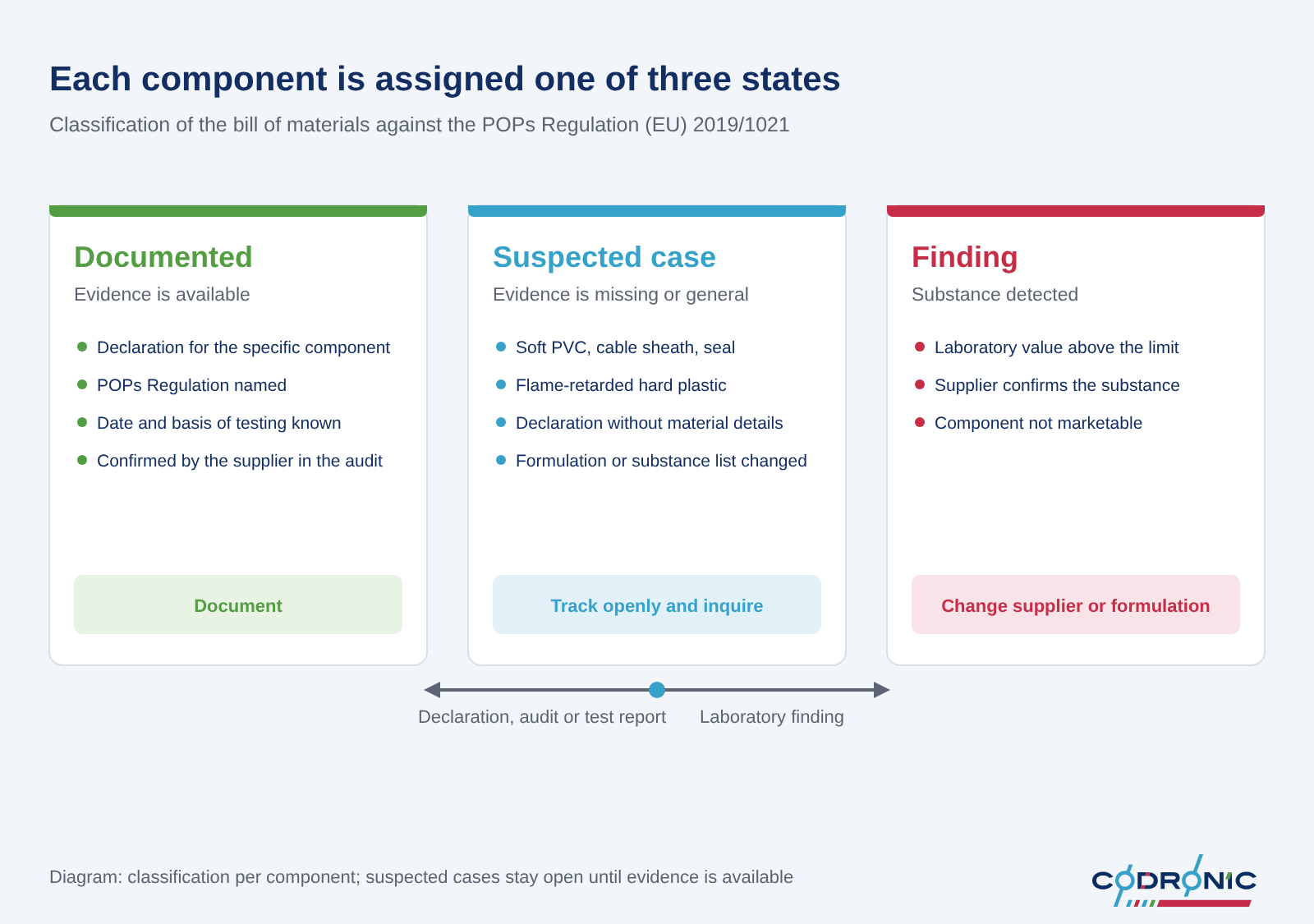
We declared and documented these components as suspected cases. For each component, it is thus traceable which risk is known and how it is being handled. The manufacturer demonstrates due care in this way and does not ignore any recognizable warning sign.
For larger and important suppliers, we had them confirm directly in the audit that the delivered products are free of POPs. The strongest evidence is a supplier or manufacturer declaration for the specific component.

It usually takes a long time until all suspected substances are declared or confirmed. Those who start early and track suspected cases openly can demonstrate their due care even while clarification is ongoing.
Conclusion
REF-10 shows: banned substances find their way into products, mostly through plastics in purchased parts. Those who know their materials at component level can answer a suspicion quickly and with evidence.
Three pieces of information are enough for an initial assessment of a suspected case: part number, material and the existing supplier declaration. Codronic takes on the classification of the bill of materials, the supplier inquiry and the records for the technical documentation, as described on the page Conformity & Documentation.
About the author
Michael Mader founded Codronic GmbH in Friedberg near Augsburg in 2009 and leads it as Managing Director. A trained toolmaker with technician training (Technikerschule) and university studies in business and economics, he is responsible for development, calculation and conformity projects in mechanical engineering. He is the inventor of patent DE 10 2024 136 675 B3.
Sources (accessed November 10, 2026; English versions November 12, 2026)
- ECHA Forum: REF-10 project report on integrated chemical compliance of products, December 13, 2023, ECHA-23-R-13-EN, Tables 1, 2, 5, 6 and 7, Section 3.5.1.
- Regulation (EU) 2019/1021 on persistent organic pollutants, Article 3 and Annex I.
- Section 10 ChemSanktionsV (Chemikalien-Sanktionsverordnung, in German).
- Section 27 ChemG (Chemikaliengesetz, in German).
- Section 14 ElektroStoffV (Elektro- und Elektronikgeräte-Stoff-Verordnung, in German).
- DXC Technology: CDX updates of October 20, 2025 (Dechlorane Plus, Delegated Regulation (EU) 2025/1930) and December 9, 2025 (PFOS, Delegated Regulation (EU) 2025/718), in German.
Frequently asked questions about the POPs Regulation
Does the POPs Regulation also apply to purchased components?
Yes. The ban covers substances in articles. Whoever places a product on the market is also responsible for the substances in purchased parts.
Which POPs are most common in industrial products?
In REF-10, 52 of the 61 cases of non-compliance involved short-chain chlorinated paraffins (SCCPs), mostly in soft plastics. PFOA and HBCDD followed.
Is a supplier’s declaration of conformity sufficient?
It is a reliable basis if it refers to the specific component, expressly names the POPs Regulation and is up to date. A general declaration without reference to material and testing is an indication, not evidence.
What are the penalties for a violation in Germany?
A violation of the substance ban is a criminal offense under Section 27 ChemG, including in cases of negligence. The penalty ranges up to two years of imprisonment in cases of intent and up to one year in cases of negligence.
How often does the substance list change?
The EU amends Annex I regularly, most recently in 2025 with Dechlorane Plus and stricter PFOS limits. A one-time check therefore becomes outdated.



CE Marking for Machinery: Process, Obligations and What Changes in 2027

Fasteners – High-Tech in a Humble Guise
