UAVs Defence vs. Strategy
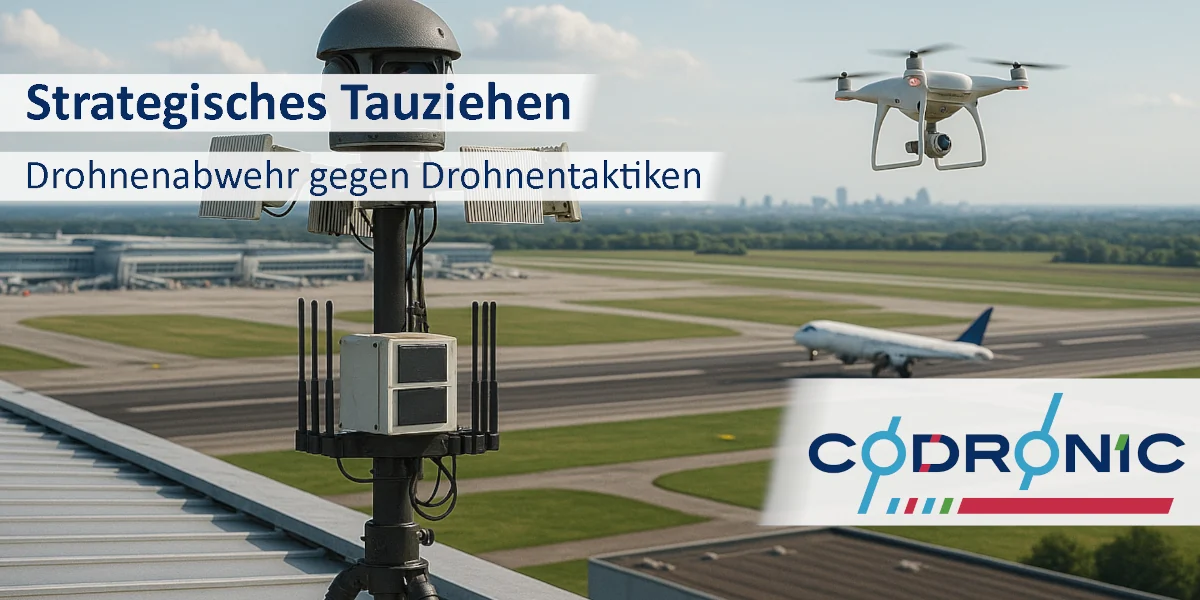
UAV Defense vs. UAV Tactics, The Strategic Tug-of-War
Police use of UAVs is increasing. They are now indispensable. They monitor crowds. They assess situations at major events. They support disaster relief operations. At the same time, recent reports remind us. Illegal UAV flights occurred over Munich Airport. This shows that the same systems do not reliably protect against misuse or disruption. This raises the central question: Where are the weaknesses in defense technologies? How easily can they be bypassed?
State of Expansion — Between Risk Analysis and Economic Viability
Authorities and operators of critical infrastructures in Germany and Europe pursue a strategy. It is risk-based and tiered. UAV detection systems are installed in high-risk areas. These are places with high potential for damage or disruption. Examples are airports, major events, and sensitive industrial areas. Usually, radar, radio, and optical sensors are combined. However, intervention techniques are highly restricted legally. This includes jammers or net launchers. Complete EU-wide coverage is not realistic. This is true neither technically nor economically. Studies show the cost. Installing one modern C-UAS system (more here) at a major airport costs around 2.5 to 3 million euros. Annual operating costs add up to 500,000 euros. For comparison: The economic damage of a two-day airport closure can be over 10 million euros. This is according to a study at Frankfurt/Main Airport. It can be significantly more at international hubs. The famous Gatwick example in 2018 caused an estimated 55 million euros in consequential costs. This comparison shows the potential. Targeted investments in defense technology can quickly pay for themselves economically. However, comprehensive prevention remains financially unsustainable. It is also technically limited. Therefore, operators focus on scenarios. They have the highest probability of occurrence and greatest damage potential. They avoid the illusion of complete protection. European agencies like EASA or NPSA explicitly recommend modular protection packages. They should be location-specific.
How Attackers Bypass Defense Systems
Attackers who want to trick defense mechanisms use simple but effective means. These include small size, low altitude, minimal radio traffic, or purely pre-programmed flight paths. Swarm attacks pose massive challenges to defense systems. The sheer number of small UAVs overwhelms radar filters and decision systems.
Typical circumvention strategies:
- Timing: Deployments at dusk or night. Optical sensors are less effective then.
- Redundancy: Many cheap devices instead of one high-quality system.
- Overloading: Simultaneous flights from different directions confuse priorities.
Current defense solutions are mostly designed for single targets. They are not for coordinated swarms. This creates an asymmetric situation. Low means on the attacker’s side tie up significant defense resources.
Weaknesses in Defense and Exploitable Attack Points
The most promising defense strategies combine early warning sensors, pattern recognition, and tiered intervention. But, even here, weaknesses remain:
- Detection gaps occur with very small or camouflaged UAVs.
- Scalability problems arise during simultaneous attacks.
- Legal restrictions exist for active measures in densely populated areas.
- Missing data integration between civil and military defense is an issue.
Attackers can exploit these points. Low-cost systems (three-digit euro range) are often enough.
Summary, Strategic Counterweights, and Trends
The relationship between defense technologies and UAV resilience remains a strategic race. Defenders invest in multi-sensor systems. They also use AI-supported recognition and tiered response plans. Attackers optimize camouflage, autonomy, and swarm coordination. In the short term, the focus is on cost efficiency and scalability. A “95 percent protection” is economically and operationally more sensible. This is true compared to a theoretically complete one. In the long term, Europe needs binding legal frameworks for intervention measures. It also needs common data platforms. Realistic cost-benefit models are needed for different infrastructures. As long as small, autonomous systems remain cheap and available, defense will never be absolute. It remains a system of technology, tactics, and politics. Those who want to protect must not only invest. They must also think strategically: What is acceptable risk and what is not?



UAV Swarms


The Green Transformation is gaining ground

UAVs in 2030