UAV Swarms
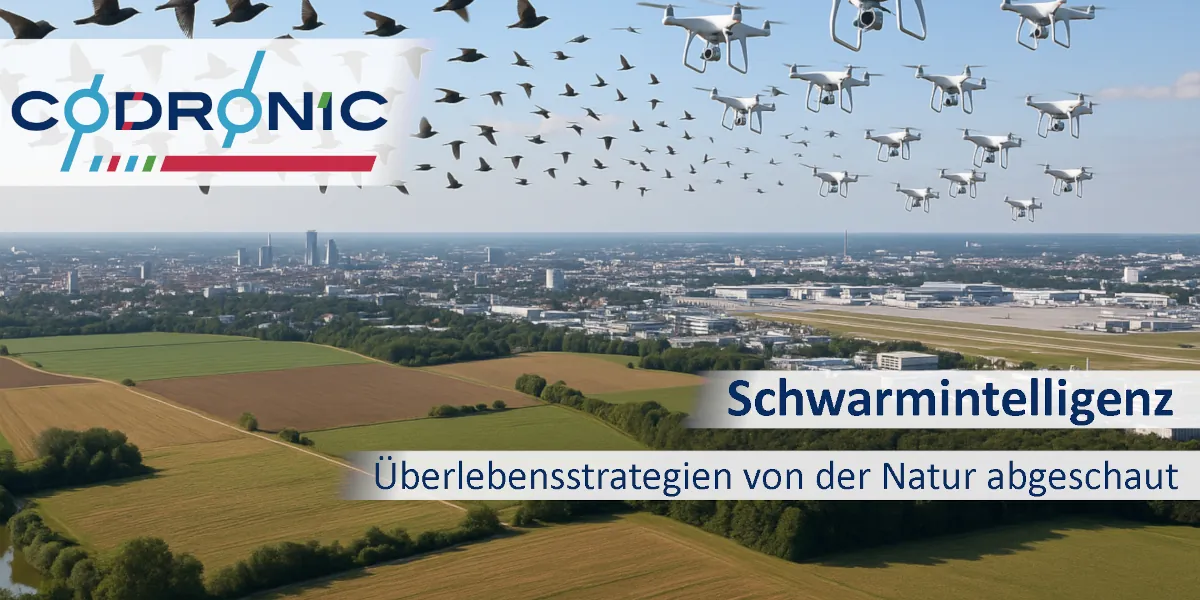
UAV Swarms: How Nature Inspires the Next Key Technology
In nature, collective movement emerges from simple local rules: keeping distance, aligning, and staying together. Birds, fish, and insects follow these principles instinctively—without a leader or data exchange. Engineers now apply the same logic to technology: autonomous UAV swarms coordinated through local rules, minimal communication, and maximum resilience.
From Biology to Technology
In biological swarms, intelligence arises from interaction. Each individual reacts to its nearest neighbors—no central control, yet complex coordination emerges. Inspired by this, engineers design decentralized multi-robot systems that operate collectively. Each UAV processes local information, adjusts its flight, and maintains formation. The result: scalable, fault-tolerant systems suited for search, logistics, and monitoring.
Why Swarms Matter
- Search & Rescue – UAV swarms can cover vast areas in parallel, compensate for signal loss, and adapt dynamically—ideal for disaster zones or dense forests.
- Environmental Sensing – Coordinated UAVs map wind fields or emissions, enabling efficient turbine optimization and environmental monitoring.
- Logistics & Industry – In warehouses or outdoor facilities, swarm algorithms distribute tasks and prevent bottlenecks without central servers.
- Defense & Security – Multi-agent formations extend range, endurance, and robustness—critical for reconnaissance and complex operations.
Core Engineering Challenges
- Communication: Low-latency mesh networks and adaptive consensus are crucial in degraded or urban environments.
- Collision Avoidance: Translating natural heuristics to 3D dynamics with multiple sensors and obstacles remains complex.
- Energy Management: Coordination shifts from individual UAVs to collective resource planning—who flies, who recharges, who leads.
- Cybersecurity: Networked swarms expand the attack surface, requiring secure firmware, update pipelines, and resilient telemetry.
From Idea to Industrial Readiness
To move from lab to real-world applications, swarms need certified software stacks, robust sensor fusion at scale, and mission resilience without GNSS. Nature teaches a key insight: emergent behavior doesn’t need heavy communication—local intelligence can outperform centralized control.
UAV swarms will become a true key technology when communication, safety, and certification are mastered industrially—scaling nature’s wisdom into everyday engineering.
More information:
- Swarm behaviour (Wiki) – Basics and Models like Boids and Couzin.
- Max-Planck-Institut für Dynamik und Selbstorganisation – Reasarch Network
- Centre for the Advanced Study of Collective Behaviour (Uni Konstanz) – International Research Network


Fasteners – High-Tech in a Humble Guise

Environmental Impact Assessment EIA