UAVs in 2030
Drones 2030: Trends, research and opportunities for small and medium-sized enterprises
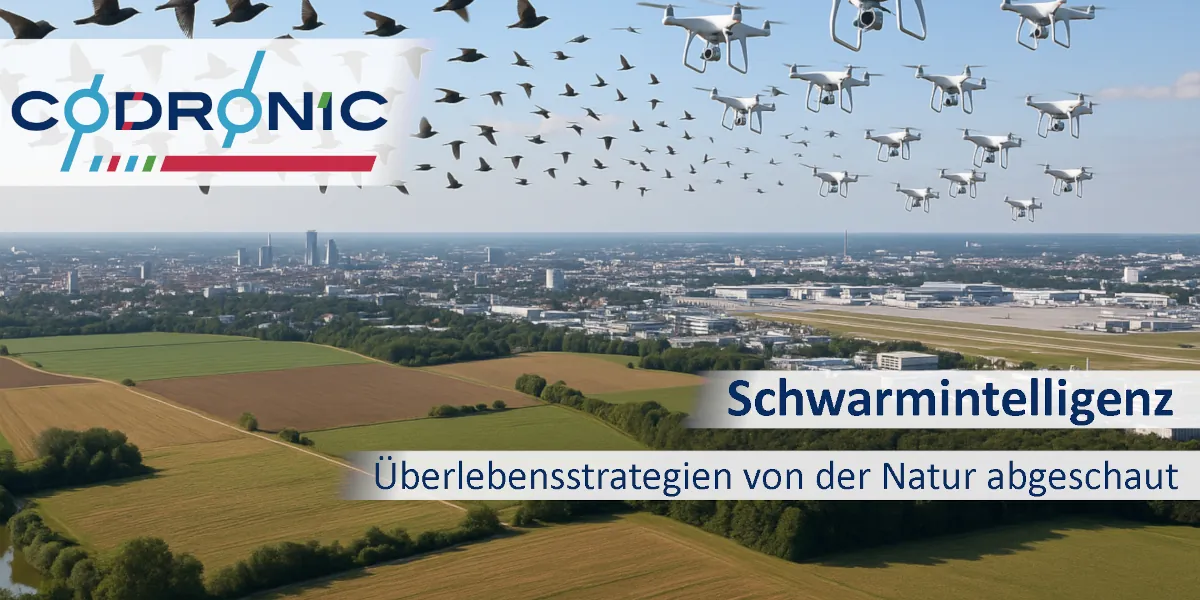
Drones are currently evolving from individual systems to highly networked, partially autonomous platforms. Researchers and industry are working on swarms that can perform coordinated reconnaissance, transport or rescue tasks. Current reviews of UAV swarms emphasise cooperative mission planning, AI-based decision-making and resilient communication. SpringerOpen
Current research
At the same time, there is growing pressure to reliably detect and defend against drones. In 2025, Fraunhofer IDMT presented an acoustic sensor solution that can locate drones even outside the line of sight and can be combined with radar, camera and lidar to form sensor systems. idmt.fraunhofer.de The German Aerospace Centre (DLR) is demonstrating interception drones and jamming methods designed to track, capture or stop unwanted drones using jamming signals. DLR
At the same time, security associations and industry see considerable gaps. An expert survey by the BDLI and recent statements by the association warn that existing systems for drone detection and defence are often inadequate and that the use of AI in particular will determine the performance of future solutions. International airspace security reports, such as those from Dedrone/Axon, also emphasise the increasing threats posed by autonomous systems and swarms, and derive trends such as AI-supported detection and adaptive counter-UAS from this. dedrone.com
At the same time, however, positive scenarios are also emerging: university and institute projects are demonstrating drone swarms for disaster control, for example to explore flood areas or to quickly assess the situation. thi.de
It’s not just research institutes that are in demand
The current trend opens up a wide field for small and medium-sized enterprises with their specialists in mechatronics, artificial intelligence and requirements engineering. SMEs are in demand when it comes to translating research results into mature products. They supply specialised components for sensor fusion, AI-based pattern recognition, secure communication and human-machine interfaces. The key here is to systematically capture requirements from regulation, security, operation and user experience and translate them into robust system architectures.
Further links:
- Fraunhofer IDMT: Reliable acoustic drone detection
- DLR: Reliable drone defense
- Dedrone/Axon: Airspace Security Predictions 2025
Future research priorities, EU strategies and funding programmes
At European level, the EU is pursuing the goal of establishing a common counter-drone framework with its drone strategy and communication line on combating threats from civil drones. The Commission emphasises the role of research and innovation, particularly through Horizon Europe, in developing and testing new solutions. EUR-Lex
In line with this, EU projects such as PRESERVE and COURAGEOUS 2 are funding the analysis of swarm threats, the fusion of heterogeneous sensor data and the development of evaluation and testing methods for counter-UAS systems. PRESERVE The European U-space and Urban Air Mobility Agenda of EASA and SESAR also addresses the safe integration of numerous drones into airspace through digitalised traffic management services. EASA
A cluster of research and test infrastructure is emerging in Germany. One example is the National Test Centre for Unmanned Aircraft Systems in Cochstedt, where the DLR is developing technologies for the detection, situation assessment and defence against unwanted drones. Projects such as ‘DrohneEx’ at the University of Magdeburg are investigating electromagnetic jamming methods. DIE ZEIT
Funding programmes such as the Federal Ministry of Transport’s ‘Innovative Air Mobility’ initiative, the funding line for civil drones and air taxis, and the BMWK’s loan programmes for aviation technologies address precisely these issues. BMV The Federal Government’s funding database provides an introduction to relevant programmes for companies and research institutions. Förderdatenbank
Summary
In our blog series, we have examined drone technology from several angles:
Types of drones: from small multicopters to medium-range reconnaissance systems to sophisticated UAVs for long-range missions.
Detection technologies: radar, radio direction finding analysis, optical and infrared sensors, and acoustic methods. Cross-sensor fusion and AI-supported classification are becoming increasingly important in order to distinguish between harmless and critical objects.
Defence technologies and strategies: jammers and spoofing, net drones, interceptor drones, directed energy and tactical measures such as zone-based protection concepts around airports or critical infrastructure.
Swarm strategies: Both as a risk, for example in coordinated attacks, and as an opportunity in logistics, inspection and disaster control. Research into swarm algorithms shows how autonomous drones can carry joint loads or cover large areas efficiently.
Overall, it became clear that technical solutions must always be considered in the context of regulation, acceptance, data protection and ethical guidelines. Ultimately, what matters to operators are integrated systems that are safe, legally compliant, economical and maintainable. Structured requirements engineering plays a key role here, as it makes technical, organisational and legal requirements transparent and prioritises them.
What’s next?
This post concludes our current blog series on drones. However, technological developments will continue to shape our world for a long time to come, and we will of course stay on top of this matter.
We would also like to hear from you:
- What aspects interest you most when you think about drones in relation to your business?
- Are they mainly technical questions about sensors, AI algorithms or security architectures?
- Is it more about organisational issues, such as operating concepts, processes or training?
- Or are regulatory issues and their translation into clear requirements for systems and suppliers at the forefront?
Feedback, queries and your own experiences are expressly welcome. If you would like to explore specific project ideas or research approaches, for example in collaboration between SMEs and research institutions, it is worth getting in touch directly.
Please use your preferred channel to contact us and let us know what topics you would like to see covered in a possible next series.


Fasteners – High-Tech in a Humble Guise

Environmental Impact Assessment EIA