C-UAVs: Principles of Operation, and Classification
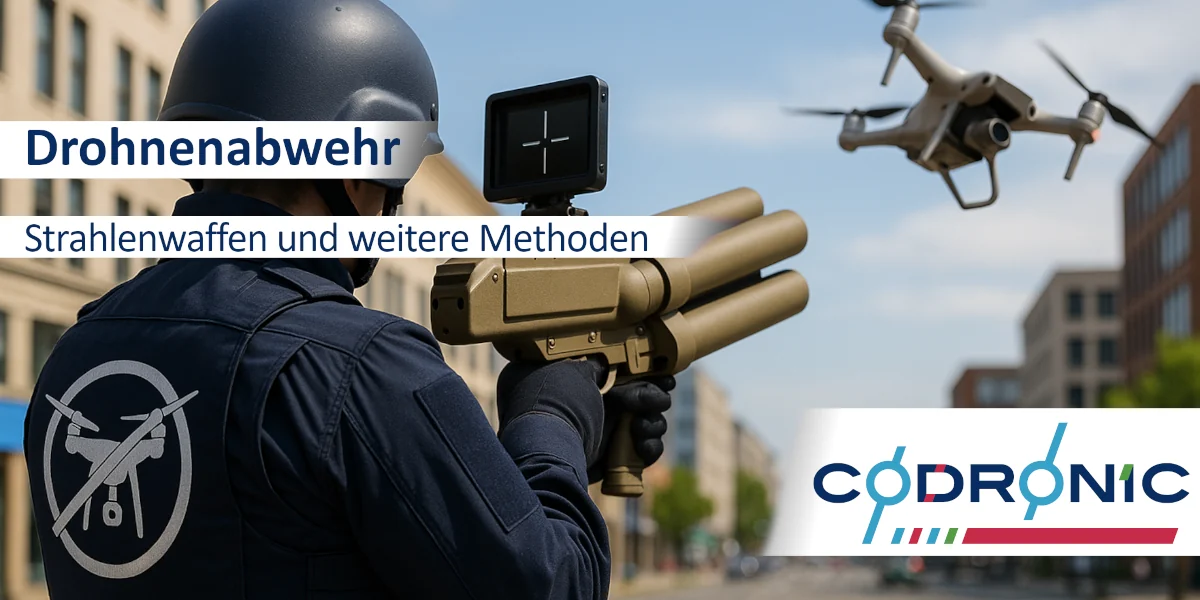
Technologies for Counter UAVs: Concepts, Principles of Operation, and Classification
Drone defense ranges widely. It covers simple radio jamming up to kinetic means. It also includes forensic recovery. Essentially, defensive measures can be classified by their points of attack. These are:
- Electronic disruption (RF, GPS, sensors)
- Optical/electronic influence (VIS/IR, camera obscuration, lasers)
- Directed energy weapons (high-energy lasers, microwaves)
- Kinetic or mechanical measures (shooting down, ramming, capture nets)
Each group has its own pros and cons. These relate to effort, legal situation, collateral damage, and effectiveness. They are relevant against both civil quadcopters and larger tactical/military UAS.
Disruption in the Radio Frequency Range: RF Jamming, GPS Jamming, Spoofing
Electronic countermeasures aim to interrupt or manipulate communication or navigation. RF jamming disrupts the control or telemetry link. GPS jamming interrupts satellite-based positioning. Spoofing provides fake navigation signals.
The advantages of these methods are their comparatively quick effect. They also cause no direct collateral damage to bystanders. Disadvantages include limited range. They are also less effective against military, secured links. They can also affect civil radio services.
Furthermore, legal restrictions are high. Unauthorized jamming is prohibited in most jurisdictions. Effort and effectiveness depend heavily on countermeasure technology. This includes encrypted links, inertial navigation, and location.
Disruption in the Visual Range: VIS and IR Cameras
Optical countermeasures target sensors. Strong glare can reduce image quality. Contrast-changing lighting can also reduce it. Smoke or particle clouds can do the same. IR deception can influence thermal imaging cameras.
Operators often use redundant sensor systems. This is in addition to camera-based navigation (SLAM, optical flows). Therefore, optical measures alone are occasionally insufficient.
The rule here is similar: simple means can impair commercial cameras. For military systems, robust, multi-spectral sensor-fusion solutions are common.
Directed Energy Radiation: Lasers, Microwaves, HPM
High-energy lasers or directed microwaves aim to destroy electronics or optical systems. They can also temporarily put them out of action.
They offer the potential for precise, “contactless” neutralization. They cause little dispersion. However, they require high technical complexity. They need high performance and cooling. Optical stabilization is also often needed. Their use is thus mostly limited to specialized systems. These are stationary or vehicle-mounted. Legal, safety, and liability issues are particularly relevant here.
Reactions to Disruption: Fail-Safe, Emergency Landing, Crash
Drones react differently to disturbances. They may initiate automatic return. They may enter hovering mode. They may land immediately. Or, with heavy interference, they may crash uncontrollably.
Military systems often have robust fail-safes. They also use redundant navigation. This includes INS, alternative GNSS, or secure radio channels.
For civil protection concepts, it is important to choose measures that minimize collateral damage from a crash or emergency landing. This is done, for example, by targeted guidance to uninhabited areas, virtual geofences, or capture nets.
Shooting Down or Ramming: Surface-to-Air and Air-to-Air
Kinetic options (surface-to-air missiles, anti-aircraft gun-like systems, interceptor drones) are usually highly effective. But, they pose risks to bystanders and infrastructure. Air-to-air intercept maneuvers (ramming, collision) are used in military scenarios. However, they are extremely risky and expensive. Such options are mainly relevant in armed conflicts. In the civil sector, they are practically unusable. This is due to the legal situation and collateral damage.
Capture Nets, Recovery, and Forensics
Mechanical methods like nets offer a lower-risk way to disable and recover drones safely. This can be done with stationary or launched nets. Interceptor drones can also be used.
After recovery, forensic analyses are possible. This includes log files and components. This facilitates investigation and prosecution. Nets are particularly effective against smaller platforms. They are usually unsuitable against larger tactical systems.
Summary: Most Effective and Most Promising Principles
A multi-layered, modular approach is recommended for a robust defense concept. This involves:
- Detection (radar, acoustic, optical)
- Classification
- Targeted reaction from a tiered defense toolkit.
Electronic disruption is fast. It is effective in many cases. But, it has legal limits. It loses effectiveness against hardened systems. Directed energy means offer precision. But, they are expensive and technically demanding. Mechanical nets and controlled recovery minimize collateral damage. They also allow for forensics. However, they are size-dependent.
Overall, combinations are most promising. These include detection, non-kinetic neutralization, and safe recovery options. These are supplemented by a legal framework and rules of engagement. This helps to avoid collateral damage.


Fasteners – High-Tech in a Humble Guise

Environmental Impact Assessment EIA