UAVs: Detection and Localization
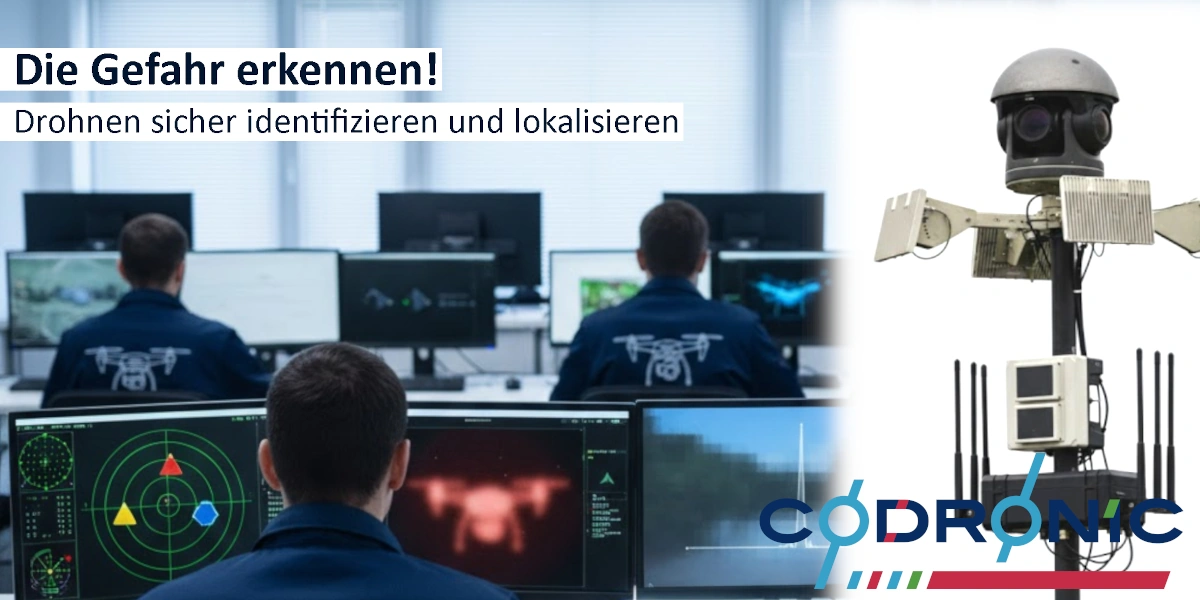
Drone Detection and Localization Capabilities, Overview of Current Technologies
The increasing spread of unmanned aerial vehicles (UAVs) creates new challenges. This affects security authorities, operators of critical infrastructure, and private companies. To ward off threats from unauthorized or dangerous drones, reliable detection, identification, and localization is crucial. Various sensor technologies are used for this. They have specific advantages and disadvantages depending on the environment, objective, and budget.
Radar Systems
Radar (Radio Detection and Ranging) uses electromagnetic waves. It detects objects and determines their distance, direction, and speed. An antenna sends out pulses. These are reflected by a target. The position and movement of a drone can be calculated. This uses time-of-flight and frequency shift.
Modern radar systems detect drones at distances of several kilometers. However, the range strongly depends on several factors. These include antenna height, terrain, and weather. Small UAVs with a low Radar Cross Section (RCS) are hard to detect. This is especially true in urban areas with many reflections and shadows.
The systems can be deployed stationary or mobile:
- Stationary systems are suitable for continuous surveillance of sensitive areas. They offer long range and network integration. However, they are costly and prone to “shadow zones.”
- Mobile radar systems are flexible to use. Yet, they usually have shorter range and lower resolution.
The effort for comprehensive or gapless border surveillance would be enormous. The systems would need to be installed at high density.
RF Scanners (Radio Frequency Detection)
RF scanners detect radio links. These connections are between the drone and the controller. They also detect links between the drone and GPS/telemetry systems. They analyze the frequency spectrum. They recognize typical protocols. This allows for the identification of the drone type. It also allows for partial localization of the pilot and the aircraft.
This technology is highly effective. This is true as long as the drone is transmitting radio signals. However, autonomous drones may be hard to detect. This also applies to drones without an active radio link or with encrypted signals. False alarms are possible. These can be caused by Wi-Fi or Bluetooth traffic.
Mobile devices exist. They are the size of a walkie-talkie. Stationary systems are also used:
- Stationary RF systems are suitable for continuous monitoring. They integrate well into security networks.
- Mobile systems are suitable for temporary use. Examples are major events or military operations. They require trained personnel. They are more susceptible to interference.
Optical Detection with VIS and IR Cameras
Camera systems use the visible (VIS) and infrared (IR) spectrum. They capture visual or thermal signatures of drones. Evaluation is mostly automated. This uses image analysis or AI-based pattern recognition.
Optical systems provide valuable identification data. This is especially true in good light conditions. However, they strongly depend on weather, lighting, and line of sight. IR cameras can be used in the dark. Still, they are more expensive and have limited ranges.
Mobile vs. stationary systems:
- Stationary systems offer continuous observation of specific areas. They can be combined with other sensors.
- Mobile systems are flexible. But, their detection performance is less stable. They are prone to motion blur or changing environmental conditions.
Acoustic Detection with Microphone Arrays
Acoustic systems detect the characteristic sound of drone rotors. Multiple microphones (arrays) are used. They determine the direction of the sound source. This uses time differences in sound arrival.
These systems are particularly suitable for short to medium distances. This is true even without line of sight. However, wind, traffic noise, or other disturbances can severely impair detection. The sound profile varies depending on the drone type and speed.
Current systems use machine learning. This distinguishes between drone sounds and background noise. Nevertheless, acoustic detection remains only a supplementary tool.
Combined Systems and AI Evaluation
Each individual technology has specific weaknesses. Therefore, modern systems rely on sensor fusion. Radar, RF, optical, and acoustic data are combined. They are evaluated using AI algorithms. These approaches allow for a significantly higher detection rate. They also improve localization accuracy.
Artificial Intelligence analyzes data streams in real time. It classifies objects. It filters false alarms. It supports threat prioritization. Current systems achieve hit rates of over 95%. This is achieved through deep-learning models. False alarm rates are simultaneously reduced.
Summary
Drone detection and localization is a dynamically growing technology field. Radar and RF scanners are the most robust detection methods. Optical and acoustic systems provide valuable additional information. The future clearly lies in multi-sensor, AI-supported platforms. These intelligently link data from different sources.
Good starting points for further articles on the current state of research and development are available. Examples are the websites of the Fraunhofer Society and the DLR. Our other blog posts on the topic of UAVs, their differences, or drone propulsion systems are also useful.


Fasteners – High-Tech in a Humble Guise

Environmental Impact Assessment EIA