Fasteners – High-Tech in a Humble Guise

Without them, our modern world would quite literally fall apart, yet we rarely pay much attention to the humble screw in our daily lives. In reality, this inconspicuous component is a masterpiece of engineering; its failure in highly complex machinery can lead to catastrophic consequences.
The Path to Standardization and Industrial Maturity
The history of the modern fastener began in 1841 when British engineer Joseph Whitworth proposed the first standardized thread system. Previously, almost every screw was a unique, custom-made piece, which made repairs and industrial manufacturing immensely difficult. In Germany, the founding of the Standards Committee of German Industry in 1918 and the publication of DIN 1 marked a decisive turning point for the standardization of technical components. Today, nearly all designs are based on international ISO standards, which guarantee global interchangeability and component safety.
Materials and the Secret of Strength
In general mechanical engineering, we frequently encounter materials such as classic S235JR structural steel or stainless steels like A2 (V2A). While S235JR has a yield strength of approximately 235 N/mm², high-strength bolts operate in an entirely different league from a technical perspective. A bolt with property class 12.9 reaches a yield strength of 1080 N/mm². This means it can support nearly five times the load before permanent plastic deformation occurs. This enormous difference results from specific alloying elements and precisely controlled heat treatments that optimize the steel’s microstructure.
The Physics of a Secure Joint
The design of a bolted joint follows strict mathematical rules, defined in Germany primarily by the VDI 2230 guideline. A central concept is the tensile stress area, which describes the actual load-bearing cross-section within the threaded region. It is used for stress calculations and is defined as follows:
In this formula, $d_2$ represents the pitch diameter and $d_3$ the minor diameter (root diameter) of the thread. During assembly, the application of torque generates the necessary preload force (pretension). This force clamps the connected components together so tightly that they act as a single unit. During operation, an additional working load acts upon the joint. The challenge for engineers is to calculate the preload such that the clamping force never drops to zero, even under maximum operating conditions. The coefficient of friction plays a crucial role here, as it determines how much of the applied torque is converted into useful clamping force and how much is lost to friction in the threads and under the bolt head. A fundamental formula for determining the assembly preload is:
Where $M_A$ is the tightening torque, $d$ is the nominal diameter, and $k$ is the nut factor (friction factor). Current technical research reports in the field of fastening technology are regularly published by institutes such as the ISAF at TU Clausthal. Further information on standardization can be found on the DIN Institute portals at www.din.de.
Assembly and Locking Systems
During the design phase, careful attention must also be paid to material pairing to prevent galvanic corrosion—for example, when combining aluminum and stainless steel in humid environments. Various approaches exist to permanently secure a joint against self-loosening:
-
Positive-locking (mechanical) fasteners using tab washers or safety wire.
-
Friction-locking fasteners by increasing friction or utilizing spring effects.
-
Adhesive-locking (bonded) fasteners using specialized thread-locking compounds.
-
Wedge lock washers, which prevent loosening through physical wedge action.
Codronic: Your Partner for Complex Systems
The precise design of such joints is a core element of modern mechanical engineering and mechatronic system development. Codronic supports you with state-of-the-art R&D and design services. Through detailed simulations and structural analysis using FEM (Finite Element Method), we ensure that your bolted joints hold up even under extreme conditions while optimizing material resources. Furthermore, we assist you with technical documentation and CE compliance, taking into account the new EU Machinery Regulation.
#Codronic #EngineeringPartner #MechanicalEngineering #Mechatronics #CECompliance #FasteningTechnology #VDI2230 #FEMSimulation #MechanicalDesign #Engineering



UAV Swarms

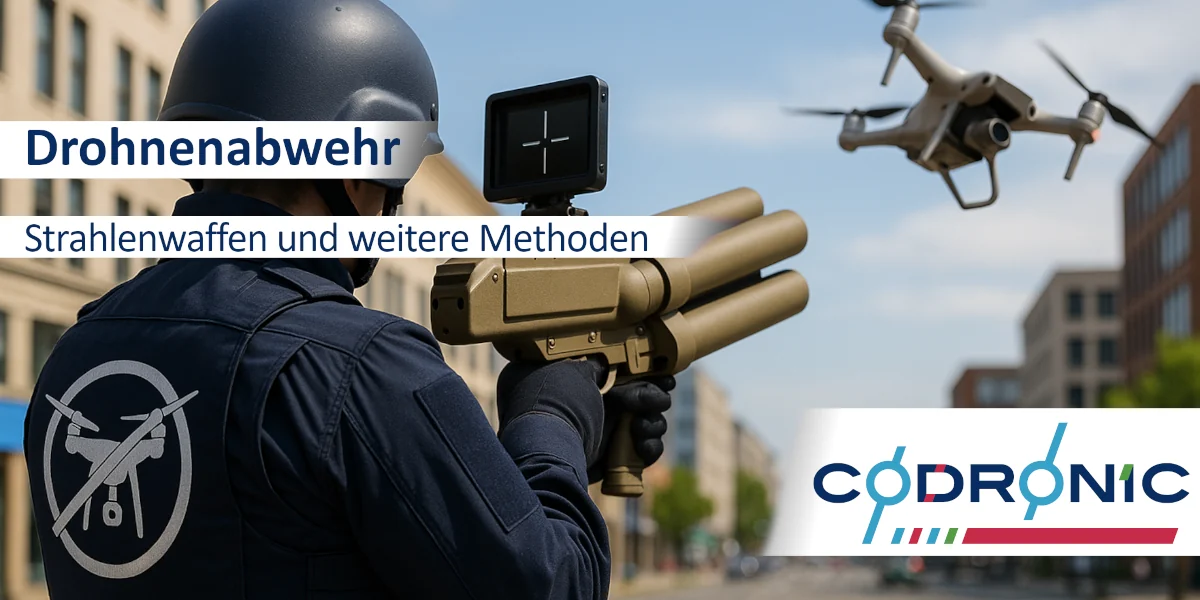
C-UAVs: Principles of Operation, and Classification

The Green Transformation is gaining ground