UAVs: Technology, Application, and Future Prospects
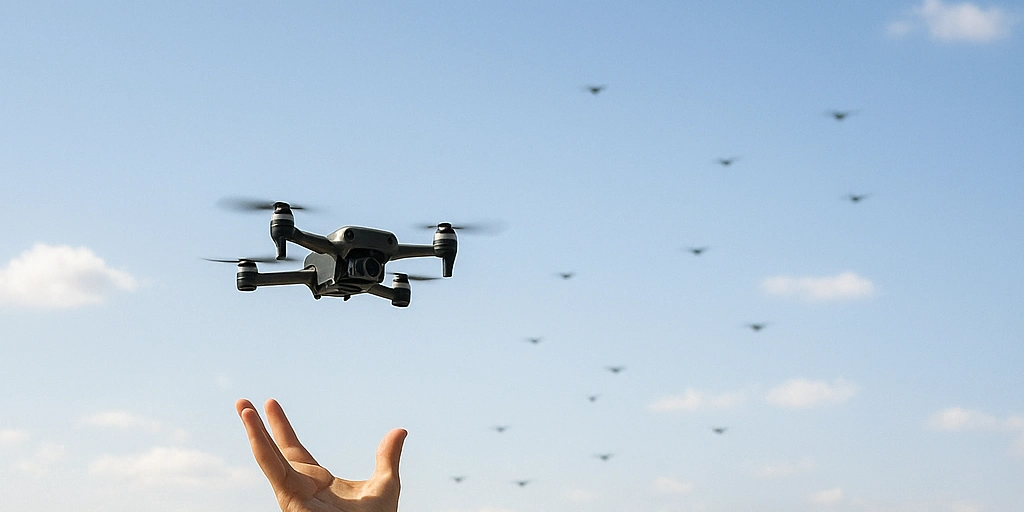
Mini-Drones Everywhere, High-Tech in Hand, High-Risk in the Sky?
Drones are mentioned in the press almost daily. Small multi-copter drones are easily accessible to the public. Models from DJI are an example. They are also easy to operate. The broad market contributes to rapid technical development. This is also found in tactical systems. Examples are the Black Hornet Nano or the Small Tactical Unmanned Aerial Systems (STUAS). It is also seen in high-precision, civil sensor platforms.
Our first blog post in the “Understanding Drones” series gave an overview of different UAV types. Today’s part highlights the key technologies and use cases of the smallest systems. It also shows where further development is needed.
Propulsion Systems – Compact, Efficient, and Quiet
Electric propulsion is the standard for small drones. High-efficiency, low-noise mini-brushless motors power them. They usually drive two to four propellers.
Lithium Polymer (LiPo) or Lithium-Ion batteries serve as the energy source. They offer a good weight-to-energy density ratio. Flight time is often only 15–25 minutes. This is true for micro and nano drones like the Black Hornet. Larger tactical STUAS systems can stay airborne for up to 2–4 hours. They use larger cells or hybrid solutions. Internal combustion engines are rare in this size class. Vibrations, noise levels, and heat generation would impair stealth and stability.
Control, Navigation, and Autonomy

Control of small drones typically uses radio remote controls. This is increasingly supplemented by tablet or smartphone interfaces. Many systems support First Person View (FPV). This means control via live video from the onboard camera.
Modern models integrate several levels of autonomy:
- Stabilized flight modes use automatic attitude correction. This is done by acceleration and gyro sensors.
- Semi-autonomous missions use GPS programmed waypoints.
- Fully autonomous missions are in high-end systems like the Black Hornet 3. This includes takeoff, flight, data acquisition, and return to base.
GNSS systems (GPS, GLONASS, Galileo) are used for navigation. These are supplemented by Inertial Sensor Systems and optical flow algorithms. Visual SLAM (Simultaneous Localization and Mapping) or ultrasonic/laser rangefinders take over orientation indoors or in urban canyons. This is where satellite signals are disrupted.
Sensors, Eyes and Ears of the Drone
Small drones have increasingly become multi-sensor platforms. VIS (visible light) and IR (infrared) cameras are standard for data acquisition. The Black Hornet, for example, combines both in a miniaturized gimbal. This provides information even at night or in smoke. DJI Enterprise-series drones also offer zoom and thermal imaging cameras. Optional Lidar scanners or multispectral sensors are available for environmental analysis.
Tactical systems in the STUAS range also integrate other devices. These include radio direction finders, SIGINT modules (Signal Intelligence), or sensors for chemical and radiological measurements. This depends on the mission profile.
Use Cases: Urban Scout to Tactical Platform
- Military and security-related applications:
- Nano-drones like the Black Hornet are used for reconnaissance at the squad level. This is especially true in urban environments. They provide real-time video behind corners or indoors. This is done without endangering personnel.
- Civilian use cases:
- DJI models are used by police, fire departments, and disaster relief. They provide situational awareness in confined buildings or damage zones.
- STUAS systems are designed for a larger operational radius. They are used for border surveillance, infrastructure inspections, or environmental measurements.
Mobility and Logistics
The Black Hornet is designed for backpack transport. It is ready for use in less than two minutes. DJI drones need a small carrying case. One person is needed for operation and maintenance. STUAS systems, however, usually require a team of two to four people. They also need a transport vehicle. This is for operating the launch and control units.
Overview of Operational Time and Preparation Time:
- Black Hornet: approx. 20 min flight time, < 2 min startup time
- DJI Mavic 3 Enterprise: 30–40 min flight time, < 5 min preparation
- STUAS (e.g., ScanEagle): 2–4 h flight time, 15–30 min system check
Summary and Outlook
The miniaturization of propulsion, sensors, and computing units has greatly expanded the use of small drones. Nevertheless, systematic limits remain. Limited flight time, restricted payload, radio range, and vulnerability to interference are central challenges.
Future research will therefore focus on:
- More energy-efficient batteries or micro fuel cells.
- Real-time data fusion from multiple sensor sources for more precise situational awareness.
- Swarm autonomy, where several small drones act coordinatedly.
- Resilience against GPS jamming and AI-supported mission planning.
These advancements could make small drones even more versatile in the future. They could be used for precise reconnaissance in urban areas. They could also automate the surveillance of large areas. Development remains a dynamic field. It challenges technology, tactics, and ethics equally.


Fasteners – High-Tech in a Humble Guise

Environmental Impact Assessment EIA