Mitigating the Skilled Labor Crisis with AI

Old machines aren’t scrap metal; they are dormant assets simply waiting for an “intelligence upgrade.” The true Industry 4.0 revolution isn’t currently unfolding in glossy new “smart factories,” but exactly where proven mechanics meet Artificial Intelligence.
Why Retrofit?
Many Small and Medium-sized Enterprises (SMEs) face a dilemma: they cannot afford entirely new high-tech production lines, yet they must automate urgently to remain competitive. This intersection is creating a massive market for retrofitting. This isn’t about humanoid robots roaming the shop floor; it’s about pragmatic, modular solutions for existing lines. It involves combining the robust mechanics of brownfield facilities with new intelligence in the form of Cobots and AI software.
In practice, this enables impressive scenarios. Consider a thirty-year-old punch press that ejects parts randomly into a wire mesh bin. Previously, an employee had to sort these manually. Today, that same machine can be retrofitted with a Collaborative Robot (Cobot), a 3D camera, and AI software.
The AI identifies the parts in their random orientation, calculates the optimal grip point in real-time, and guides the robotic arm into the bin without collisions. The legacy press remains in place, and the automation is simply integrated alongside it. Similarly, in quality control, a camera system with edge computing learns to distinguish “good” from “bad” parts simply by being shown examples of defects—no manual coding required.
Key Application Areas
The following fields currently dominate the retrofitting trend:
-
AI-Driven Bin Picking: Using intelligent vision systems for machine tending.
-
Adaptive Quality Control: Self-learning camera systems at the end of the conveyor belt.
-
Collaborative Welding or Gluing: Implementing automation for small batch sizes through “lead-through” programming (teaching by demonstration).
The Engineering Challenge
While hardware is commercially available, the actual engineering challenge lies in brownfield integration. Legacy machines often lack digital interfaces. Engineers must retrofit I/O-Link masters or tap signals directly from the Programmable Logic Controller (PLC) to enable communication between the old and new systems.
Another critical factor is safety. As soon as a Cobot handles a sharp-edged workpiece, it becomes a hazard. This often raises the question of whether the retrofit constitutes a “substantial modification” to the machine. This has massive implications for CE compliance. Industry reports and economic analyses confirm that regulatory uncertainty is often the biggest deterrent for operators.
Your Partner for Secure Integration: Codronic
Implementing such projects safely requires a partner with a broad technical horizon. This is precisely where Codronic excels. As your development partner, we offer more than just mechatronic system development and special-purpose machinery for the physical integration of new components.
Our expertise specifically includes CE compliance and technical documentation. We perform risk assessments and determine whether a new CE marking process is required, providing you with full legal certainty. Furthermore, we support you with simulation and validation to ensure your new processes are stable. Whether in mechanical engineering, battery technology, or the defense industry, we make your legacy assets future-proof.
#Codronic #EngineeringPartner #MechanicalEngineering #Mechatronics #CECompliance #Retrofitting #AI #Industry40 #Automation #Cobots


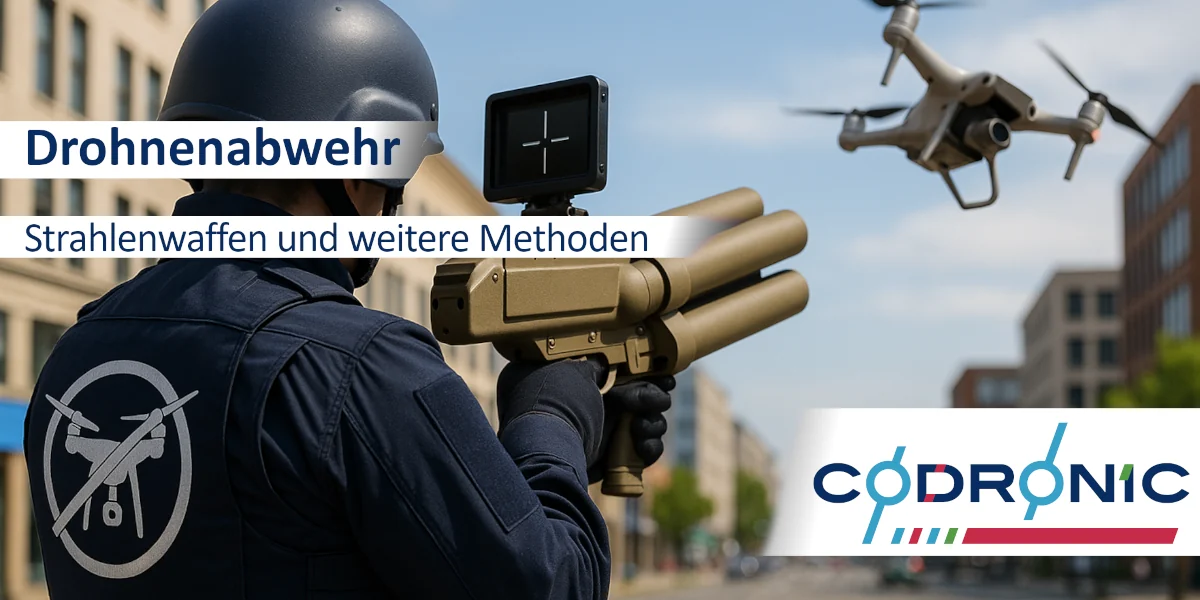
C-UAVs: Principles of Operation, and Classification


Fasteners – High-Tech in a Humble Guise

Environmental Impact Assessment EIA